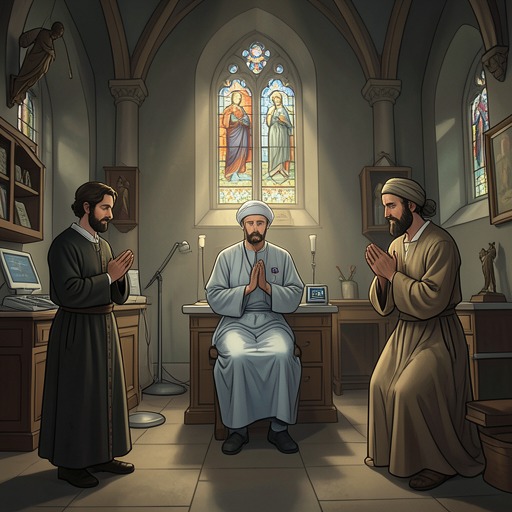
La prière n’est que la fumée des illusions consumées
Felix Austria“La prière n’est que la fumée des illusions consumées” is the image through which Stefania understands prayer at the edge of the novel’s catastrophe: not as a plea dependent on a miraculous icon, but as smoke left by illusions already consumed. The phrase binds private self-deception to the story’s public uncertainty over miracles, sacred objects, and the forces that seem to make them disappear.
The Phrase in the Final Scene
Stefania speaks of prayer while imagining herself as a somnambulist on a roof, swaying over a bottomless precipice. She has become her own illusionist, deceiving herself while also playing to an audience willing to submit to hypnosis. Against that image of divided agency, prayer no longer requires miraculous icons; it is the smoke of illusions burning away and dispersing into the sky. The metaphor does not promise that belief has simply vanished. Instead, it presents prayer as what remains when the structures of certainty that sustained belief have been consumed.
The thought arrives at the moment when Stefania is nearly extinguished and can make out only Adèle’s faint heartbeat. Others rush into the room as the roof collapses, burying the burning scene beneath multicolored glass. The phrase therefore stands between inward recognition and material destruction: its smoke-like prayer disperses even as the fire becomes literal, the house falls, and the objects long missing from places of worship spill from the stone woman’s jar around the two women.
Miracles, Objects, and Explanations
The story’s earlier disappearances make the phrase’s reference to illusions more than a private metaphor. At Ozeriany, an ancient monstrance vanishes from the cathedral of Saint Anne without a trace: the doors are locked, the windows intact, and the interior undisturbed. The absence invites a supernatural explanation, as though angels had carried the object through the walls into heaven. Yet the unexplained thefts also permit ordinary suspicions. When Josef and Petro discuss the growing number of missing valuables and relics, Petro suggests that members of the religious institutions themselves might be responsible; Josef, in turn, points to the coincidence between the disappearances and performances by Ernest Thorn, a magician and swindler.
The lost things belong to different communities and forms of worship. A silver etrog box disappears from the Old Synagogue at Tchortkiv; its rabbi says it contained something else too, a secret that must never be revealed. At Brody, a sacred kiddush cup, a hanukkiah with a walking golden lion, and an emerald-inlaid yad vanish. The losses prompt a remembered Brodersinger pantomime in which Yahweh Sabaoth carries the Jewish people toward the heavenly Jerusalem: first objects, then temples, animals, and houses disappear, followed by saints, sages, musicians, and children, until no Jew remains on the sinful earth. The image turns theft into an apocalyptic sign, while leaving open whether the interpretation describes a real supernatural withdrawal or the fearful meaning people impose on unexplained events.
At the end, the stone woman’s fallen jar produces a physical inventory that brings the scattered reports together. The monstrance and the two golden patens—one depicting the Nativity at Bethlehem, the other Christ’s tomb—lie alongside a jeweled case, the silver etrog box, the blackened kiddush cup, the golden-lion hanukkiah, and the emerald-inlaid yad. Their appearance among the flames makes the disappearances materially legible without removing the mystery surrounding their passage into the house. The objects connect the Christian and Jewish episodes through the same image of sacred things lost, carried, and exposed.
Prayer and the Limits of Religious Certainty
Elsewhere, Josef’s attention to the miraculous icon of the Virgin of Tenderness in Stanislaviv’s Armenian cathedral shows a different effort to understand sacred power. He studies a register recording dates and names associated with healings and visions, treating the testimonies as evidence while remaining fascinated by the relation between hypnosis and faith. His interest in Charcot’s comparison of hypnotic and religious experience makes the boundary between miracle and psychological mechanism a live question rather than a settled answer. The icon is at once an object of devotion and a phenomenon Josef tries to explain.
The requirement that confession take place inside a church gives religious practice a concrete institutional boundary. When Stefania asks Josef to hear her confession outside a prison church she cannot enter, she argues that a sinner, a priest, and God are already present. His reply holds to the rule that he cannot perform confession beyond the church. The scene sets immediate spiritual need against the conditions governing a sacrament; it does not make prayer and confession interchangeable, but shows how access to religious consolation can be constrained by place and form.
Josef’s later discourse on the commandments, the Law of Moses, service, submission, and love of God offers another account of devotion. He describes divine love as surpassing the distinction between the person who serves and the manner of service, and presents humanity’s capacity to resemble God as dependent on human will. Beside these teachings, Stefania’s closing image is more precarious: prayer remains possible without a miraculous icon, but appears as smoke from an illusion that has burned out. The phrase gathers the novel’s unresolved tension between faith as lived practice and the desire to explain, verify, or escape the conditions under which belief takes shape.